Aero Study Report

Typical Airtightness and operational leakage of New Homes in New Zealand

Outline

Background

This report summarises airtightness results from new-build homes completed last year. It provides a practical snapshot of how new homes in New Zealand are typically performing.

The sample includes production builders as well as those aiming to deliver above-Code homes. The builders in this sample are generally more aware of airtightness and actively working toward better outcomes. As a result, the pre-airsealing results in this report are likely to be somewhat better than the wider industry average.

Understanding Airtightness

Airtightness is measured in air changes per hour at 50 Pascals pressure difference (ACH50). The lower the number, the tighter the building and the less uncontrolled air leakage occurs. The scale below shows how different performance levels relate to real-world outcomes.
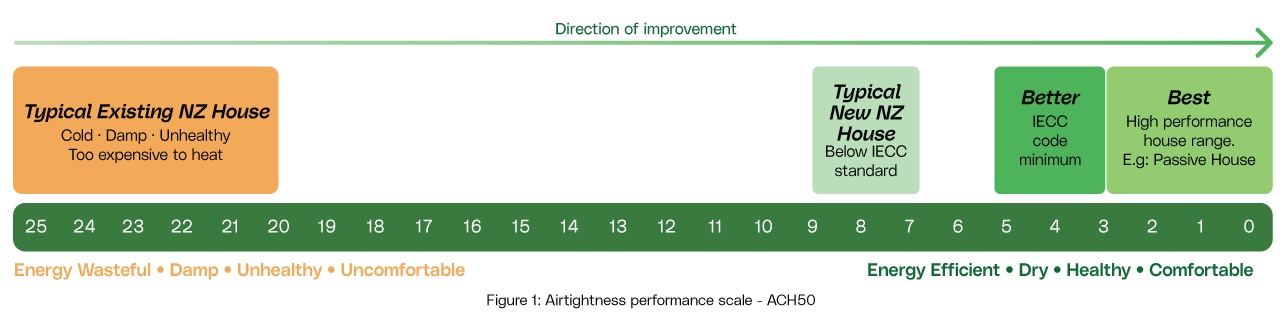
Figure 1: Airtightness performance scale — ACH50

The older New Zealand homes Aero has sealed sat in the ‘Poor’ zone, leaking at over 20 ACH50 due to construction methods – very hard to heat and likely unhealthy to live in.

Aero has taken old houses from above 20ACH50 to below 5ACH50 through improved airtightness and ventilation retrofits.

New homes in the sample, performed on average at around 6–8 ACH50 – still well above IECC code minimum standards. Homestar and Passive House homes, sit in the ‘Best’ range of below 3 ACH50.

Aero enabled the New houses we airsealed to meet IECC, Homestar and even Passive Home standards through the AeroBarrier process.

The IECC (International Energy Conservation Code) is a widely adopted model building code developed by the International Code Council; most comparable countries set a minimum airtightness requirement in their building code of between 3 and 5 ACH50.

Highlights

  • Most of the homes in the sample were aiming for High Performance Home standards so the average in this sample will be far more airtight than a traditional new home.

  • New homes in the sample averaged around 6–7 ACH50 airtightness after adjustment

  • Results across the sample showed wide variation in performance, ranging from approximately 4.21 to 10.72 ACH50, highlighting the influence of build quality and envelope detailing.

  • The results closely align with international research from Australia, where typical new homes measure around 7–9 ACH50, suggesting similar construction outcomes across both markets.

  • Airtightness is highly dependent on build quality and envelope detailing, with large performance differences even within the same builder category.

Sample Overview

Type of Project
Sample Size
Avg Masked (ACH50)
Avg Adjusted (ACH50)
Highest (Adjusted)
Lowest (Adjusted)
New Build
43
5.56
6.56
10.72
4.21

Masked

Masked: Envelope-only airtightness test with operational components sealed (rangehoods, ducts, hatches, doors, windows).

Adjusted: Masked result + 1 ACH50 to reflect expected operational leakage once systems are unsealed and functioning. This allowance is based on post-airsealing blower door testing data.

Masked vs Adjusted Results and Operational Leakage

Airtightness results are reported in two forms:

Masked (Building Envelope): Operational components such as rangehoods, ducts, hatches, doors, and windows are masked out to measure the airtightness of the building envelope alone (walls, roof, floor, and fixed junctions).

Adjusted (indicative operational): An allowance is added to reflect expected in-service airflow from components designed to open, move, or ventilate.

Operational leakage represents normal airflow from items such as:

  • Rangehood and bathroom exhaust dampers
  • Ducts and flues
  • Attic hatches
  • Sliders and window seals

This leakage is not a defect; it reflects the building operating as intended. Airtightness systems (e.g., SIP panels, intelligent membranes, AeroBarrier) are designed to improve the envelope but are not intended to eliminate operational airflow. We do not want to seal the operational units up.

Based on testing of masked and unmasked homes, a practical allowance of +1.0 ACH50 has been applied to reflect a reasonable operational figure. An indicative range of +0.5 to +1.5 ACH50 is appropriate for normal construction, depending on dwelling type, number of service penetrations, and the quality of operational components and their installation.

Insights from the Data

1. New builds remain relatively leaky on average

Based on Aero empirical data:

  • Average adjusted airtightness across the sample: 6.56 ACH50
  • Range: 4.21 to 10.72 ACH50

On the airtightness scale above, an average result of 6.56 ACH50 significantly above IECC levels and more than three times leakier than an average high-performance benchmark of 1.5 ACH50.

CSIRO / ATTMA Research (Australia): Average new home: 8 ACH50 (single storey: 7 ACH50; two storey: 9 ACH50).

New Zealand production housing appears consistent with Australian data. While performance has improved over the past decade, average airtightness remains well above high-performance benchmarks.

At the better end of the sample, some builders recorded adjusted results in the low 5 ACH50 range, reflecting the impact of higher specification and focused quality management. Despite this, even the best performance was still above 4 ACH50 (adjusted).

2. Variation within the sample is significant

The spread between best and worst results across the sample was approximately 6.5 ACH50 — a substantial range for what is nominally the same building type.

Insight: Airtightness is one of the most variable aspects of construction quality. Without deliberate envelope control, results are inconsistent and unpredictable.

3. Design intent alone does not guarantee performance

Even among projects targeting higher performance, airtightness varied significantly. Execution quality and envelope detailing remain the primary determinants of outcomes, regardless of specification.

Overall Observations

  • Average production housing in this sample sits between 6–7 ACH50 (adjusted), placing it well short of normal international standards
  • Results align closely with CSIRO and ATTMA international data.
  • The spread between best and worst homes remains substantial within the sample.
  • Airtightness in mainstream construction remains largely unmanaged rather than systematically controlled.
  • The ECCHO assumption that a “typical” new home starts at 5 ACH50 does not reflect this dataset. Actual averages are materially higher, indicating that the potential value of improving airtightness may be understated.

Conclusion

The data indicates that:

  • Airtightness performance in new builds remains highly variable.
  • Higher design standards alone do not ensure consistently low leakage.
  • Envelope detailing and build quality are the primary determinants of performance.
  • New Zealand industry airtightness averages are broadly consistent with Australian findings.
  • Better outcomes are achievable with higher specifications and deliberate control


This dataset highlights a clear opportunity for more systematic airtightness management to improve consistency and reduce overall leakage in new housing.

Sign up to our newsletter

Receive industry updates, case studies, and research on airtightness, ventilation and energy efficiency.

Book CPD presentation

(10 Formal CPD points)